
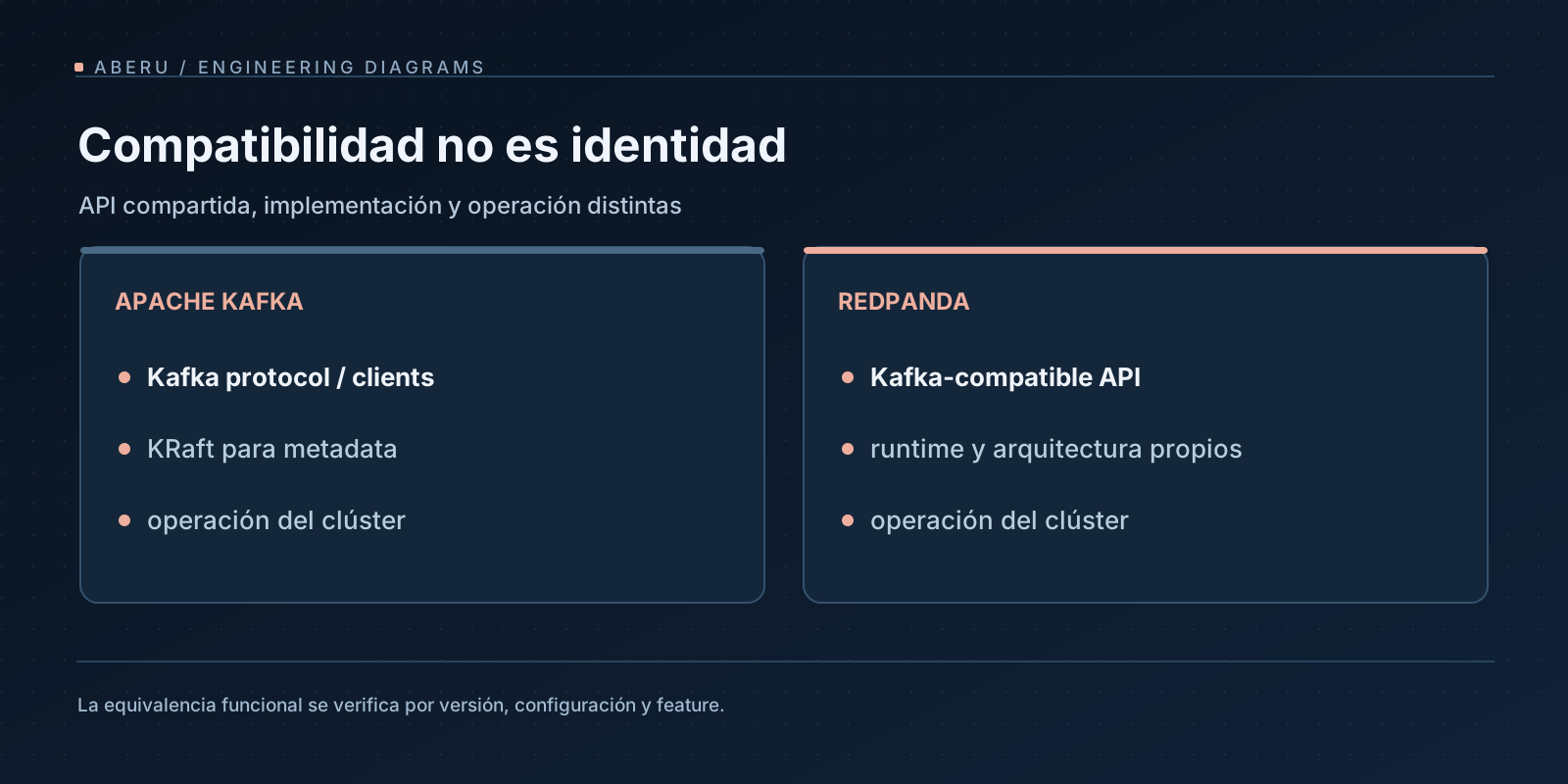
That two brokers accept Kafka protocol customers doesn’t mean they’re the same platform. Nor does it mean that you always gain performance. The actual decision affects the perseverance design, write guarantees, cluster monitoring and the load of equipment that operates them.
That article updates the original comparison for Apache Kafka 4.4.0 and Redpanda 26.2 with documentation consulted in November 2026. I have been unable to conduct a Benchmark and have put both products into production. The above text attributed a test of 1 million events per second and CPU / latency improvements without verifiable data: these figures are deleted. He also misstated that Kafka needs ZooKeeper and Kafka 4.x works with Kaft.
The useful question isn’t “what’s faster?” but “what guarantees, compatibility and operational costs do I need for this flow?” **.
Before comparing: what does an event broker do
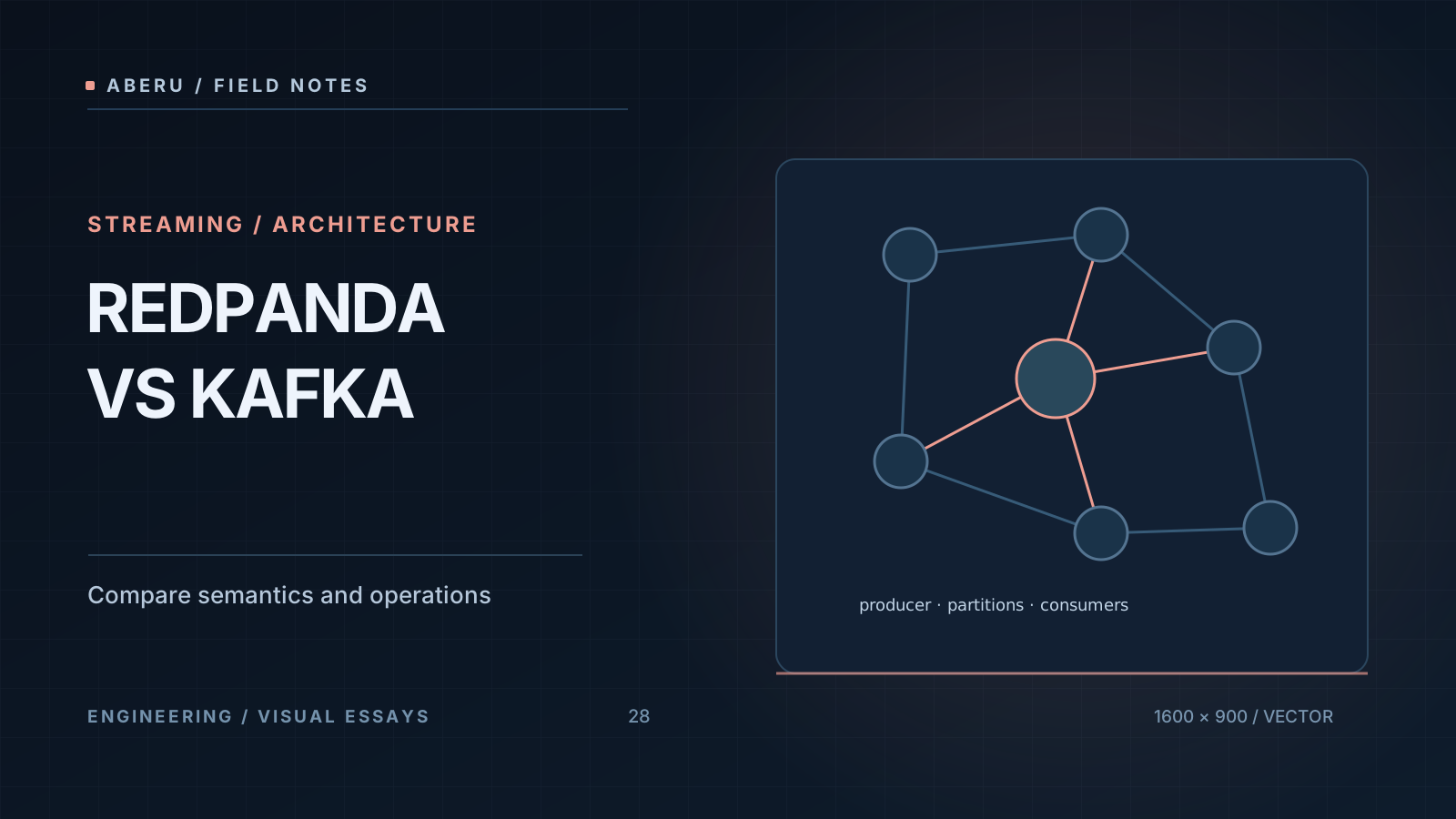
A producer puts his records into a * topic *. The topic is divided into * partitions *, which are sorted log logs. Consumers read offsets within these partitions and a consumer group can share them with its members. The retention allows you to read data while they are available. The replication offers fault tolerance under specific conditions but does not replace backups, proven recovery or retention controls.
A partition is simultaneously a unit of order and an important unit of parallelism. If a key concentrates all traffic into a single partition, adding consumers cannot distribute its processing within that group. That model problem develops at Kafka: diseñar claves de partición sin romper el orden.
The systems can share this visible interface and greatly differ how they implement the monitoring, replication, cache and run plane.
Kafka 4.4: KRat, broken and segmented logs
Kafka remains with log segments in the filesystem. It relies on pat cache, batching, compression and operating system mechanisms as sendfile as soon as the transfer path allows. Your performance should not be reduced to “being written in Java”: network, disk, configuration and access pattern matter as much as the runtime.
In Kafka 4.x, ZooKeeper’s no longer an operation mode. KRat uses a quorum of controllers that keeps the cluster metadata using a replicated log. Data partitions maintain their leaders and replicas while the quorum of metadata coordinates status changes. They’re not the same cape.
The distinction also matters when diagnosing malfunctions: loss of connectivity with a controller, insufficient RSI, pressure from a broker’s disc and consumer delays are different incidents. A properly deployed cluster does not amount to a system without human intervention.
Consumer groups: protocol also has version
Kafka 4.4 includes the traditional protocol classic and protocol consumer associated with KIP-848, which reached general availability at Kafka 4.0. The new protocol removes the global synchronization barrier from the classical rebalance and moves to the server some of the management of Heartbeat, times and assignments.
That doesn’t mean that all customers will be using it automatically: it depends on the version, client configuration and broker. If re-balancing times are compared, the effective protocol and assignment strategy have to be reflected in the results. KIP-848 and documentación de Kafka are the references for these differences.
Redpanda 26.2: implementation by core and Rat consensus
Redpanda implements the Kafka protocol from a different architecture: native code at C++, asynchronous performance using Seastar and design * menad-per-core *. Divide performance and memory access by * share * to reduce co-ordination between nuclei. That can change how to consume CPU, treat latency and dimensional nodes but by itself doesn’t prove a quantitative advantage at any load.
At Redpanda, each data partition acts as a group Rat and there is also a replicated monitoring partition for metadata. Comparison with KRat requires a distinction between Kafka’s Fat and Repanda’s use of Rat for the log of each partition.
There’s an outside ZooKeeper process at Redpanda but also at Kafka 4.4. The actual operational difference includes nodes topology, reserved memory, monitoring, display conventions, tool compatibility and availability of licensed functions.
References: Redpanda: architecture and release notes 26.2.
A widely supported API isn’t semantic identical
Redpanda can care for producers and consumers of the Kafka family and valid recent customers but compatibility requires to look operation by operation. A client who correctly publishes and consumes does not prove that another component of the platform behaves as well.
A concrete example is min.insync.replicas. Kafka uses this setting, with acks=all, in its policy of acceptance of scriptures according to the number of synchronized replicas. Redpanda accepts the compatibility option but does not implement it with the same effect: with acks=all, confirms after a majority of partition replicas have the registration, regardless of the value set up in min.insync.replicas.
Other documented differences affect quotas, authentication mechanisms, specialized APIs and transaction protocol details. Redpanda 26.2 indicates, for example, that Kafka 4.x customers can use the earlier transaction protocol if the most recent version isn’t available. The exact list changes by version: matriz oficial de compatibilidad.
Projected compatibility test: before migrates, run on both destinations * same * production, consumption, transaction, authentication, rebalance, scheme and broker failure, and preserve relevant responses and configurations. “The API Connects” is just the first check.
Durability and command: specify before optimization
No single option called “secure writing.” For each flow, we have to describe the replication factor, the confirmation requirement, the policy with nonavailable replicas and an acceptable risk of loss or duplication.
At Kafka, an idempotency production company needs acks=all, activated retirees and up to five requests * in flight * per connection. Within these boundaries, there’s no need to fix max.in.flight=1 only to maintain an idempowerful production order. If idempotency is disabled and there are reattempts with more than one request in flight, reordering may occur after an error. It’s a concrete protocol / client property, not an end-to-end business guarantee.
# Ejemplo de parámetros Kafka Producer, no configuración universal de clúster
acks=all
enable.idempotence=true
retries=2147483647
max.in.flight.requests.per.connection=5
compression.type=zstd
linger.ms=10
That fragment has not been tested against a broker in this research. To adopt it you have to review the total timeout, the target lengput, acceptable latency, available compression and client versions. The broker configuration lays down other boundaries. Source: Kafka producer configuration.
Kafka’s transactions can coordinate write and offsets consumed inside Kafka. A notification sent to an outside API, a collection processed by a third party or a write in another database does not automatically inherit exact -once. The article about pipelines at Blog 06 develops the outbox patterns, idempotency and fill out when that text is published.
Schema Registry and ecosystem: evaluating concrete capabilities
Kafka has an extensive ecosystem: Kafka Connect, Kafka Streams, customers, monitoring tools and registration. Not all this ecosystem forms part of Apache Kafka’s binary and Apache projects, commercial services and automanage supplements should be distinguished.
Redpanda has components and integrations from its platform, including support related to Schema Registry, to say that it always needs to mount an alien registry or that Kafka includes it as a serial would be wrong. The comparison requires to set which product, editing, software API and compatibility policy required. A contract with Avro / Protobuf / JSON Schema should prove compatible and incompatible changes to the scheme and should not simply verify an endpoint.
We also have to look at how they are deployed, scaled and retrieved Connectors, who stores their offsets and what SLA has with the ecosystem in its contracted edition.
Licences and operational capacity
| Dimension | Apache Kafka 4.4 | Redpanda 26.2 |
|---|---|---|
| Core | Java / Scala, brokers and KRat drivers | C++ / Seastar, run by shard and Rat |
| Cluster metal | KRat controller quorum | Reacted Control Partition |
| Data logs | Reactions with filesystem | Partition logs replicated by Rat |
| Kafka clients | Protocol reference implementation | Extent compatibility with documented exceptions |
| Basic leave | Apache-2.0 | Community under BSL and Enterprise with additional conditions |
| Business functions | Dependent on chosen distribution / services | Some skills require Enterprise |
The Redpanda Community issue should not be described intersectitiously as Apache -2.0a. Certain capabilities, such as level storage, * Shadowing * or advanced controls, can depend on editing or license: check la documentación oficial de licenciamiento. The prices and contractual restrictions vary and there have been no monthly costs.
The TCO isn’t just the price of nodes: includes provision, storage, support, guard personnel, upgrades, compliance, backup, recovery, version and operation changes to the system and connectors platform. That something’s a single binary doesn’t automatically turn it into a single-piece operation.
How to run a measurable comparison
A useful benchmarking has hypotheses, configuration, metrics and controls. A fair trial does not require identical adjustments if that artificially degrades an architecture but does document the equivalent intention and explain the differences.
| Variable | What to register |
|---|---|
| Version | broker, client, driver, kernel, instance type |
| Infrastructure | CPU, RAM reserved, network, disc, filesystem, TLS / SASL |
| Methodology | nodes, replication factor, partitions, controllers, placement |
| Producers | Key size and distribution, compression, acks, batching, concurrently |
| Consumers | number of groups, protocol, speed, backpressure conditions |
| Implementation | war-up, duration, repetitions, load and loss distribution |
| Results | useful haven p50 / p95 / p99, CPU, RSS, disc, network, rate error, lag and recovery |
A reasonable matrix would propose messages of *1 KiB and 16 KiB , 12 / 48 / 192 partitions **, uniform and focused loads, producers with different levels of batching and controlled challenges of leaders. The tests are propose and have been discontinued. They have to be stopped safely at an isolated lab, never at an actual cluster with third party data.
The results of the historic benchmarking published by Redpanda compared much older versions (Kafka 3.2.0 and Redpanda 22.2.2) with infrastructure and specific conditions. That’s evidence from the manufacturer, and not an independent proof of what’s going to be today. Guía de OpenMessaging Benchmark de Redpanda.
Choose with a decision matrix, not with a slogan
If a Kafka infrastructure already exists and the equipment can operate with SLOS, the costs of migration, security policies and functional compatibility are likely to matter more than a speculative improvement of latency. If the system starts from zero and the computer values a concrete operational experience, Redpanda deserves a test with its actual load and with revised editing limits.
For either of them, the quality of * partition keys * and consumers can master pipeline behaviour. Continue with el análisis de particiones, distribución y orden.
The final criterion is false: select the one that meets the necessary guarantees and SLOs measured with lower total cost and acceptable risk. Without a controlled experiment, there’s no universal winner.
Main sources
- Apache Kafka 4.4 / documentación oficial
- Kafka: diseño y almacenamiento
- KIP-848: nuevo protocolo de consumer groups
- Redpanda: arquitectura y fundamentos
- Redpanda: compatibilidad con clientes Kafka
- Redpanda: novedades 26.2
- Redpanda: información de licencias

